

Status: September 2026
The Berlin Senate approved the city-wide heating plan on 16 June 2026. For the first time, this provides a strategic framework for Berlin's climate-neutral heat supply by 2045. What matters now is how the heating plan is implemented: with open data, effective participation, social protection for tenants and a clear exit from fossil and resource-intensive combustion technologies.
Climate-neutral and affordable − heating the heating transition according to the Berlin heating plan 2026
Heat supply is the largest single item in Berlin's climate balance sheet. Around 40 percent of the capital's greenhouse gas emissions are generated by heating with coal, gas and heating oil. This does not only affect the climate: Producing and processing these fuels Significant damage in the countries of origin and make us dependent on mostly autocratically governed supplier states. The gas price crisis following Russia's war of aggression against Ukraine has shown how quickly this dependence can lead to life-threatening heating costs. In the meantime, further blackmail attempts by the Trump administration are being added.
In addition to the many individual oil and gas heating systems, the operators of Berlin's district heating networks also burn large quantities of fossil fuels, in particular coal and gas. These include the state-owned BEW GmbH with its 80 percent subsidiary FHW Neukölln AG and BTB GmbH, which belongs to the E.ON Group. Despite the high emissions, the connection to a district heating network is currently considered a possibility to comply with the legal obligation for climate-friendly heating. In return, companies are obliged to reduce their emissions. As of 2030, they are expected to use at least 40 percent renewable energy and have completely phased out coal.
The Berlin heating plan 2026
But where in Berlin is there a prospect of a connection to a heating network in the future and where not? The Berlin Heating Plan 2026, adopted by the Berlin Senate on 16 June 2026, answers this question. It contains maps and analyses of the heat supply, the building structure, the potential of renewable heat and waste heat as well as an implementation strategy.
In the Berlin heating plan, everyone can read what kind of heat supply is likely to come into question at their place of residence. The maps show heat supply areas in five-year steps up to 2045 and serve as orientation. However, they do not replace individual energy advice or a concrete commitment to follow-up.
What the Heat Supply Areas Mean
The heat plan distinguishes between expected heat supply areas. They show which heat supply solutions can be suitable and available in which areas.
District heating areas: A connection to a district heating network is possible here.
Decentralised areas: In these areas, heat pumps are particularly suitable – either for individual buildings or jointly organised in a local heating network.
Areas of test: Here the options are open. Maybe a district heating connection makes sense, but maybe also a local heating network with a suitable heat source. For individual buildings, a separate heat pump can be the best solution.
Why Combustion Is Yesterday's Technology
For thousands of years, fire has kept people warm. However, combustion is basically an inefficient, resource-intensive and pollutant-rich principle. High-quality energy sources are destroyed to produce comparatively low temperatures for heating purposes. From several hundred degrees of combustion temperature, about 20 degrees of room heat becomes at the end. At the same time, carbon dioxide, nitrogen oxides, particulate matter and, depending on the energy source, other pollutants are produced.
The central technology of the heat transition is heat pumps. With the same energy input, they generate three to five times as much usable heat as other heating systems by absorbing existing heat from air, soil, water, sewage or waste heat and raising it to the required temperature level using electricity. Since 2022, heat pumps have consistently been cheaper than fossil heating systems. They are not only suitable for new buildings, but also for existing and even listed buildings and even with a not yet completely renewable electricity mix, they significantly relieve the climate.
The warmer the used heat source and the lower the required flow temperature, the more efficient the pump works. This means: Good insulation, efficient heating systems and as productive an environmental or waste heat source as possible further reduce power consumption and costs.
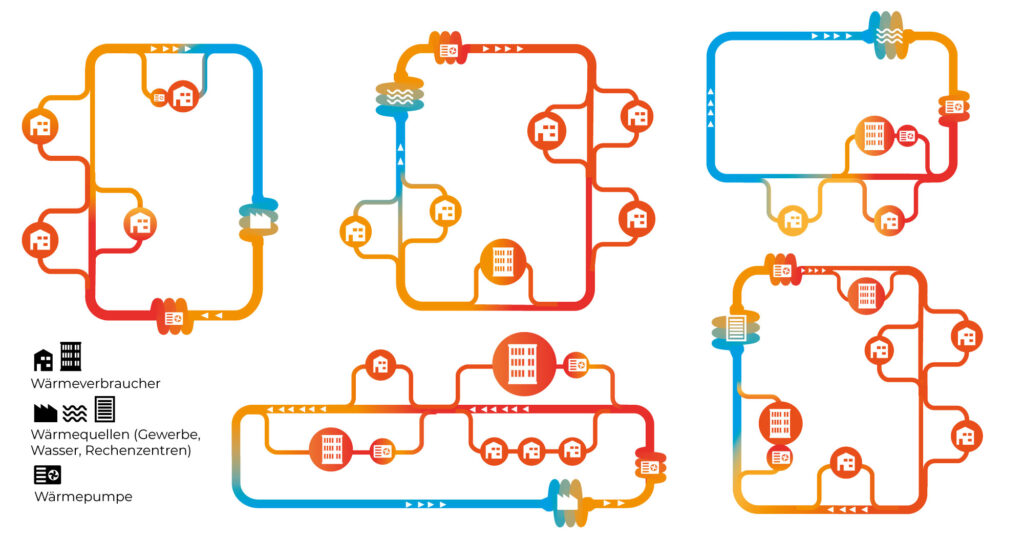
Today, heat pumps are state-of-the-art – not only in single-family homes, but also on an industrial scale and in heating networks. They open up even low-temperature heat sources such as wastewater, rivers, tunnels or data centers for heat supply.
Nevertheless, various combustion technologies continue to be considered ‘climate neutral’ by law. These include wood and other fuels from biological sources, hydrogen produced from renewable electricity and waste incineration, also because it is considered ‘unavoidable’ for the disposal of non-recyclable waste.
Especially large district heating networks with high operating temperatures and long lines are historically designed for combustion. It therefore seems obvious to their operators to simply switch to other fuels called ‘climate neutral’ and thus formally comply with the legal requirements. This path has also been followed so far.
But a heat transition that continues to focus on incineration – whether from gas, wood, garbage or hydrogen – only shifts problems, rather than turning them into waste.ösen.
The limits of ‘climate neutral’ combustion options
hydrogen
Heating hydrogen is inefficient and expensive. With the same amount of electricity, a heat pump generates about five times as much heat as a hydrogen heater. In addition, it will: hydrogen Stay close and expensive for the foreseeable future. Outside district heating networks, it will therefore play no role in heating. The shortened heat planning has already shown that the construction of a hydrogen distribution network in Berlin does not seem to make sense anywhere. Even within the heating networks, its use must be kept to a minimum in order to avoid high prices and supply risks.
Closing a possible supply gap for hydrogen from fossil sources, such as natural gas, would lead to the heat transition ad absurdum. Hydrogen production from natural gas causes significant greenhouse gas emissions It is associated with energy losses of at least one-third. Heating with fossil hydrogen would therefore consume more natural gas than if it were directly burned.
Wood and biomass
The burning of wood A balanced climate balance only on paper open. In fact, wood emits more CO per kilowatt hour of heat generated2 Free as natural gas. However, this CO₂ is attributed to the land-use sector and not to the energy sector. Power plants burning wood or other biomass can therefore formally – but counterfactually – declare their emissions as “CO₂ neutral”. Since the land-use sector has so far hardly been obliged to protect the climate, emissions at this point also remain without consequences for polluters. This is particularly problematic in view of the fact that forests have been affected by droughts, beetles and forest fires in recent years. They became CO₂ sources.. This means that they emit more greenhouse gases to the atmosphere than they absorb and thus contribute to the climate crisis. This balance continues to deteriorate as more biomass is extracted from the forest and burned. Dead wood or remnants of tree precipitation also bind carbon if they remain in the forest, and also support the regenerative capacity and biodiversity of the forest.
Even the use of old and residual wood or wood from own plantations increases the pressure on the forests. Because wood that is burned is missing for another material use, for example in the furniture industry. These industries then switch to other, often fresh wood, partly imported from distant regions. Biomass grown especially for combustion, for example from short rotation plantations, provides only limited quantities and harms biodiversity as a monoculture.
Already today, wood is so scarce in many regions that biomass power plants temporarily stand still because their operation no longer pays off. Nevertheless, numerous heat suppliers are planning new plants. Further price increases are therefore foreseeable, with negative consequences for the environment, climate and heating costs.
Waste incineration
Berlin is pursuing a zero-waste strategy. This means: By 2030, the amount of waste from households and businesses is expected to fall by 20 percent. Accordingly, the amount of energy from waste incineration will also decrease – even if Berlin should dispose of its waste quantities, which are currently incinerated in Brandenburg, in its own urban area in the future.
Waste prevention through repair, recycling and recycling is an important Contribution to climate and resource justice It saves millions of euros annually. Waste incineration should therefore not be further expanded.
| Carbon capture is not a solution
In view of the high carbon dioxide emissions from wood and waste incineration, the idea is obvious that power plants with plants for the capture of CO2 from the exhaust gas flow. Apart from the fact that such a separation is very energy-intensive and expensive, these systems have so far only worked poorly. The efficiency of power plants is reduced by up to half, but only part of the emissions are actually absorbed. In addition, the transport and final storage of carbon dioxide has not yet been secured. In the end, billions of dollars are at risk for taxpayers and consumers without any measurable benefit for climate protection. |
What to do if not burn?
geothermal energy
Geothermal energy, which translates to geothermal energy, takes advantage of the fact that the deeper you drill, the hotter it gets in the underground. At a depth of 1,500 to 2,000 meters below the capital, rich deposits are suspected, which could cover up to 20 percent of Berlin's heat demand. Whether they are actually usable, however, only becomes apparent after elaborate and expensive drilling. Currently, the state of Berlin is collecting better data on the underground. In 2025, the first measurements (2D seismics) were made in Lichtenberg and Marzahn-Hellersdorf. Now, 3D images of the subsurface are produced from all districts where geothermal drilling is generally permitted, i.e. not in the southeast. At the end of 2028, the results should be available and show where a test hole would be particularly promising. The state of Berlin intends to carry out three test drillings itself. The results can then be used by heat suppliers to tap into sources for their heating networks.
It is easier with near-surface geothermal energy, which is drilled to a depth of 400 meters. The quantities of heat that can be tapped there are not likely to be sufficient for the large district heating networks, but are suitable for smaller networks.
Waste heat and environmental heat
Although Berlin does not have large central waste heat sources from industrial plants, it does have many different, mostly rather weak heat sources: Wastewater, data centers, cold stores or smaller industrial plants and last but not least the surface waters of Berlin. A flow heat pump at Schöneweide already uses the heat of the Spree, another in Mitte is planned. Wastewater heat is also increasingly being tapped into. BEW's large district heating network is used directly at the wastewater treatment plant in Ruhleben, which provides a particularly high amount of heat. Numerous smaller networks use sewers throughout the city.
Data centers are already firmly integrated into the heat supply. At the same time, however, they are an obstacle to the heat transition because they compete with the large heat pumps for the coveted connections to the power grid. This shows: In order for the electricity grid to make the heat transition, which is also electrification, possible in the coming years, it must be strengthened on a large scale.
Local heating networks
In a city with many, rather small and decentralized heat sources such as Berlin, modern local heating networks are particularly suitable. They operate at lower temperatures, making them efficient and cost-effective to operate. They are built by both public companies – such as Berliner Stadtwerke – and private companies such as GASAG. In addition, there are cooperative models. Depending on who owns and operates the local heating networks, this can have advantages or disadvantages for end customers. Public or cooperative networks can work for the common good and also offer an opportunity for financial or political participation. For tenants, however, constellations can become problematic in which two private, profit-oriented companies (homeowners and heat suppliers) conclude a contract, but the tenants have to bear the costs.
Investments of billions nötig – how do we prevent the heat transition from becoming a cost trap?
The key technologies of the heat transition are favorable in operation, but initially require high investments. The think tank Agora Energiewende has calculated that the expansion of the heating networks and their conversion to renewable energies will cost around 200 billion euros by 2045. These investments are a public task and must not be financed by converting them to heat prices.
Even more expensive, however, is simply to continue as before. Basically, because the climate crisis is already costing billions. For 2024, the General Association of Insurers the damages caused by extreme weather events in Germany alone amount to 5.5 billion euros – and this is only the sum taken over by the insurance companies. In addition, many fossil power plants are getting old and need to be replaced anyway.
At the same time, the cost of fossil fuels is increasing, partly because of the CO₂ price, which will increase in the coming years, but also because uncertainties on the world market are increasing, especially in the case of natural gas. In addition, gas network charges become a significant financial burden for those who do not modernise their heating in a timely manner – additional costs of several thousand euros per year are realistic within a few years. The reason: More and more households and businesses are opting out of purchasing gas because they are switching to heat pumps, but the gas grid is not shrinking, so that the constant costs are distributed on fewer and fewer shoulders. Environmental associations are therefore calling for binding plans by gas network operators on how they intend to shut down their networks in the coming years in order to have clarity in time and to prevent cost explosions.
sources
Factsheet "An end to natural gas" https://power-shift.de/ende-fuer-erdgas/
Position paper ‘Do not heat hydrogen!’ https://power-shift.de/positionspapier-kostenfalle-wasserstoff/
Explanatory page ‘Hydrogen: ecologically and socially fair’ https://power-shift.de/campaign/wasserstoffwelt
Information paper wood burning https://power-shift.de/wp-content/uploads/2025/03/2024_Infopapier_Holzverbrennung_Fernwaerme_Berlin.pdf
Info paper "Berlin: Focus on energy and raw materials transition’ https://power-shift.de/rohstoffwende-berlin/
Press & Background
For interviews, audio and data please contact:
Adrian Bornmann
Speaker for press and public relations
Neelke Wagner
Climate and Energy Policy Officer
With the kind support of:

The sponsored institution is solely responsible for the contents of the publications. The positions presented here do not reflect the position of the Senate Department for Economic Affairs, Energy and Enterprises.


