Public billions for mining: Closing gaps in standards, transparency and accountability
Introduction: The need for raw materials must not be at the expense of people and the environment
Global demand for metals is growing rapidly, especially in the context of energy and digital transformation. At the same time, industrial mining worldwide is experiencing massive Environmental degradation, violations and social conflicts.
Public financial institutions play a key role in this: They provide loans, guarantees and shareholdings and make many mining projects possible in the first place. However, the analysis shows that existing Human rights and environmental standards, transparency rules and accountability mechanisms are not sufficient to effectively limit the significant risks of this sector.
A particularly impressive example is the Sangaredi bauxite mine in Guinea: Its expansion has been secured, among other things, by international financial institutions and government guarantees. As a result, there were large-scale land losses, resettlement of entire communities and ongoing conflicts over water access and livelihoods. To this day, many of those affected are waiting for adequate compensation.
The case exemplifies how public funding can contribute to human rights violations and environmental degradation – and how closely it is linked to global supply chains, where trade also plays a central role (more on this in the contribution to Metal trading as an underestimated power in global commodity chains).
Billions for metals: Growing financial pressures
Mining projects are among the most capital-intensive in the world. Decades often pass from exploration to production, with significant financial, environmental and social risks.
Nevertheless, governments and public banks are planning to invest in so-called Critical raw materials Significantly expand. The aim is to secure industrial supply chains and reduce geopolitical dependencies. However, this strategy is too short: It focuses unilaterally on expanding supply, while systematically underestimating the social and environmental costs of mining. A sustainable alternative requires a comprehensive Reversal of raw materials, which focuses on reduction, efficiency and circular economy.
Public Finance as a Power Factor
Public banks and government instruments act as Anchor investors. They reduce risks for private investors and mobilise additional investments. In this way, they determine not only whether projects are implemented, but also under what conditions.
It is precisely here that the decision is made as to whether the environment is protected, human rights are respected and affected communities are involved – or whether economic interests are given priority. Public funding This is a key lever for the direction of the entire sector. At the same time, it is often overlooked that trade structures reinforce this dynamic.
Who finances mining
The financing of mining projects is carried out through a complex interaction of various public actors. Multilateral development banks, national promotional banks and commodity funds as well as export credit agencies play different roles – from direct project financing and risk hedging to mobilising private investment.
What they have in common is that they public funds They operate and therefore have a special responsibility. Nevertheless, numerous examples show that this responsibility has not yet been consistently exercised. This is particularly evident in concrete case studies on mining projects and their impact (see e.g. our analyses on: Mining projects).
The reality: Environmental Destruction and Human Rights Violations
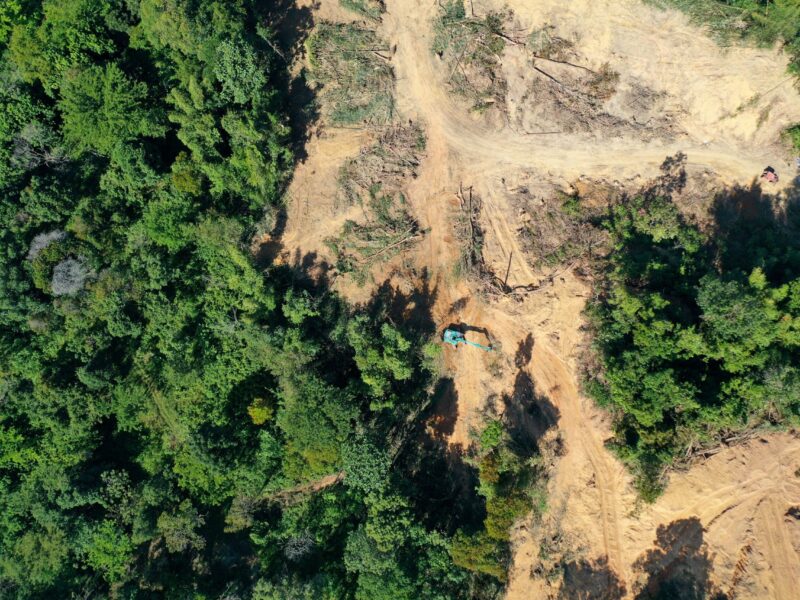
The effects of mining are often documented. Projects repeatedly lead to the destruction of ecosystems, the pollution of water and soil as well as to displacements and land conflicts. Indigenous rights They are disregarded and in many cases there is violence against those who oppose the projects.
These problems are not a marginal phenomenon, but structurally with the current Financing model connected. At the same time, they are closely linked to global trade and investment structures (see also our work on this topic). Claim and exploitation).
Standards exist but are not effectively implemented
It is true that there are international frameworks for the protection of the environment and human rights. In practice, however, they often remain ineffective. Standards are often non-binding, inadequately controlled or circumvented by complex financing structures.
It is particularly problematic that Human rights risks are not systematically audited and affected communities are often not effectively involved. This also reveals key gaps in existing regulatory frameworks such as the Supply Chain Act and the EU Due Diligence Directive.
Non-transparent funding undermines democratic control
Transparency is a prerequisite for accountability and participation. But especially in the mining sector, central information is often hidden. Affected people often do not know who is financing a project or what risks exist.
The lack of disclosure of financial structures and project information makes it difficult for civil society actors and local communities to exercise their rights and influence. Democratic control This significantly weakens the problem, which is also reflected in the commodity trade (see Metal trading as a blind spot).
Lack of accountability and inadequate complaint mechanisms
Even where there is damage, there is often a lack of effective means of enforcing rights. Complaint mechanisms are often difficult to access, not independent enough and limited to formal examinations.
A clear focus on redress Missing. Similarly, there are hardly any binding rules for dealing with projects where serious violations occur.
What needs to change: Reorient public funding
In order to align the financing of mining with human rights and environmental standards, fundamental reforms are necessary. These include in particular:
- binding and enforceable standards for the environment and human rights
- Comprehensive transparency along the entire financing chain
- effective complaint mechanisms with access to redress
In addition, a fundamental change of perspective in raw materials policy is needed. Instead of relying unilaterally on new funding projects, the Reduced raw material consumption and the Circular economy be consistently expanded.
Conclusion: Public money cannot finance new conflicts
The expansion of public mining financing is increasingly presented as a geopolitical necessity. In fact, however, it threatens to exacerbate existing global inequalities and further fuel ecological crises.
Public financial actors must live up to their responsibilities and consistently invest in Human rights, environmental and democratic control. This requires not only better rules, but a fundamental change of course – towards less consumption of raw materials and more Global justice.
At the same time, attention must be paid to the entire value chain, from financing to dismantling and trade.
Press & Background
For interviews, audio and data please contact:
Adrian Bornmann
Speaker for press and public relations
Vanessa Fischer
Policy Officer for Raw Materials Policy
Find out more about this topic in our podcast “Kompass Weltwirtschaft”.
Click here for more publications on mining and raw materials.