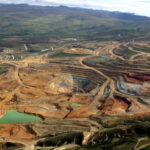
Mining of raw materials in the Brazilian Amazon: Climate policy at a dead end
1. Starting point: 1.5 degree target exceeded
The extraction of raw materials in the Brazilian Amazon region symbolizes the contradictions of global climate policy. Although it was agreed in Paris in 2015 to limit global warming to 1.5 degrees Celsius, this limit was already exceeded for the first time in 2024. The concentration of greenhouse gases in the atmosphere reaches new highs; The first climate tipping points were exceeded in 2025.
2. Decarbonisation increases pressure on raw materials
Governments are responding with plans to decarbonize the economy. However, these strategies significantly increase the demand for metallic raw materials – especially if the absolute consumption of resources does not decrease elsewhere. At the same time, only a comparatively small proportion of raw materials flow directly into the energy transition.
3. Mining in protected areas: serious consequences
For the extraction of raw materials, mining projects are also being promoted in regions with high biodiversity and great importance for climate protection. This has serious consequences for:
- the people living there, in particular indigenous and traditional communities;
- Environment and biodiversity
- the regional and global climate
4. Amazon region: Dismantling, infrastructure, pollution
The background paper shows how the mining of metal ores such as aluminum, iron or copper in the Brazilian Amazon destroys forests, pollutes rivers and threatens habitats as well as the rights of indigenous and traditional communities. The focus is not only on mining itself, but also on the infrastructure for processing and export, which causes additional interventions in sensitive ecosystems.
5. International supply chains: Responsibility of Germany and the EU
The extracted raw materials reach Germany and the EU via international supply chains. They are used, among other things, in cars, infrastructure projects and consumer goods. Through demand, import structures and consumption patterns, Germany and the EU bear a decisive responsibility along global supply chains.
6. Key question: Reduce resource consumption, protect livelihoods
Against this background, the central question arises: How can we use fewer resources and effectively protect livelihoods, biodiversity and human rights?
7. Example Niobium – Raw materials policy at odds with climate policy
The Profile Niobium – metal between energy transition, high-tech and upgrading illustrates in an exemplary way how raw material policy decisions can undermine the goals of climate and biodiversity protection. Niobium is often advertised as a key material of the green transformation, but has played a central role so far, especially in the armaments and heavy industry. More than 80 percent of the world’s funding comes from Brazil and is linked to massive environmental degradation, water pollution and human rights violations, including in environmentally sensitive regions. The profile shows why an expansion of mining is not necessary in terms of climate policy and why instead consumption reduction, prioritization of socially necessary applications as well as binding human rights and ecological due diligence obligations are central to a coherent raw material and climate policy.
8. Political conclusion: Thinking together about raw materials and climate policy
Climate change conferences need to address these issues. A just raw materials and climate policy can only succeed if climate protection, resource insufficiency and the protection of sensitive ecosystems and affected communities are thought together and implemented in a politically binding manner.
Publication and promotion
cooperation
In cooperation with the Research and Documentation Centre Chile-Latin America (FDCL) and cooperation with Brazil (KoBra) published.
This publication is funded by ENGAGEMENT GLOBAL on behalf of the Federal Ministry for Economic Cooperation and Development.