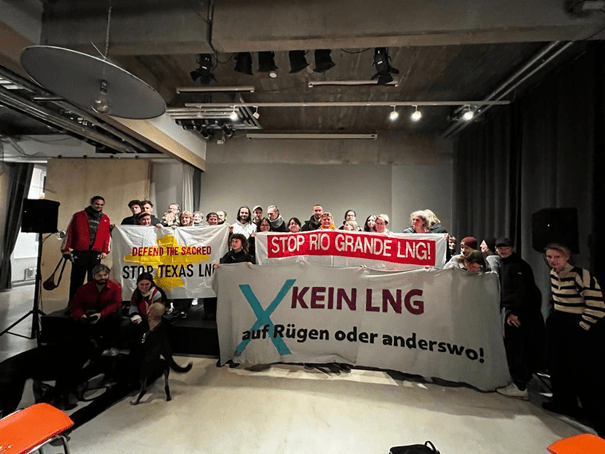
Activists from the USA and Germany at a meeting in Berlin. Their common goal is to push for a gas exit and to prevent liquefied gas infrastructure.
After the end of Russian gas supplies, Germany wants to replace its demand primarily with liquefied natural gas (LNG). However, its promotion and transport have a serious impact on people, the climate and the environment. In Germany, these are so far little known. At several meetings, activists from Texas, Senegal and Mozambique reported on the consequences of the German and European hunger for gas for them.
"Since natural gas was discovered in the province of Cabo Delgado, the region has slipped into catastrophe," says Mozambican sociologist João Feijó, a guest at a Conference of the Mozambique Coordination Group in Bielefeld. The political economy of Mozambique is still strongly marked by colonialism and marked by great inequality within the country. In the poor northeast of the country, several large extractivist projects have displaced numerous people and destroyed their traditional sources of income. They do not benefit from the few new jobs. This has led to high levels of frustration among the population and has fuelled years of smoldering conflicts in the region, leading to a civil war in 2020. “The discovery of natural gas was not the cause of the riots. However, the high expectations that have fuelled these planned projects as pure export projects and the subsequent frustration and disappointment that prosperity and work have failed to materially fuel the conflict", says Feijó. While the central government in the capital Maputo remains convinced that gas production would bring prosperity to Mozambique, it advocates focusing on sustainable development in the region, based on the socio-economic situation of the people and existing economic structures. LNG production for European and Asian markets will remain an "alien" with no benefits for local people. Last but not least, gas exports are driving the climate crisis. Mozambique is one of the five countries in the world most at risk – from increasingly frequent droughts, floods and hurricanes, such as Cyclone Idai in 2019, which caused severe devastation that remains unresolved to this day.
Sacrificed Zones in Texas
In Texas, some communities have been suffering for many years from the terrible consequences of an intensive oil and gas industry, as four activists reported at an evening event by Andy Gheorghiu, PowerShift and the MovementHub in Berlin. Chloe Torres, Melanie Oldham, Rebekah Hinojosa and Elida Castillo come from various coastal cities in the Gulf of Mexico, near which liquefied natural gas (LNG) terminals either already exist or are being built, often in addition to existing petrochemical facilities. In these terminals, fracking gas is liquefied to be shipped, among other things, to Germany – the US is currently Germany’s largest LNG supplier. In addition, there is the Texas ban on fracking, combined with the very lax regulations of this technology. This has led the activists, their neighbors and families, to face fracking in their immediate neighbourhood without receiving official information about the dangers they have been exposed to from the chemicals used and the drilling. Flaring, the flaring of unused natural gas, also causes severe air pollution. The consequences are serious: ‘Our homeland is a ‘sacrifice zone’, say the activists, an area ‘sacrificed’ to the fossil fuel industry to ensure corporate profits. They belong to the ‘cancer belt’, an area where far more people than the US average develop cancer, which is due to emissions from the petrochemical industry. Respiratory diseases, cardiac and circulatory problems as well as skin diseases are also widespread.
Because these severe consequences of the fossil industries mainly affect poor, black, LatinX or indigenous communities, which also benefit far less often from the profits from these industries, the activists speak of environmental racism. The few jobs that people from the surrounding communities can get in the facilities are dangerous and poorly paid. Other sources of income, such as fishing and tourism on the actually very picturesque and species-rich Gulf coast, are being pushed back by environmental degradation. Added to this is the growing threat of climate change, which increases the number and impact of hurricanes in the region and raises sea levels.
German banks and companies join forces
German investments are directly responsible for these devastations. The German Environmental Aid (DUH), Urgewald and Andy Gheorghiu Consulting have researched, German banks and companies have provided more than €4.5 billion over the past decade for LNG infrastructure projects at sites in the United States. Some plants are already in operation, others are still under construction. The lenders include Deutsche Bank, Bayern LB, Helaba, LBBW and KfW Ipex Bank. Deutsche Bank leads with 1.7 billion euros, followed by LBBW with 1.3 billion euros. In Germany, the counterparts to infrastructure in the USA, LNG import terminals, are currently still floating, temporary facilities that have already been supported with billions of taxpayers' money by the federal government. In addition, fixed installations are to be created that will enable gas imports by ship in the long term. In order to quickly complete these terminals, an LNG Acceleration Act was adopted, which speeds up approval, procurement, environmental and verification procedures. Public participation will continue, but will be reduced to two weeks. A terminal on the island of Rügen, whose infrastructure is laid out by a marine protected area, was approved.
Gas platform vs. fishing in Senegal
There are also such plans in Senegal. "From 2024, a platform in the sea on the border with Mauritania will be used to extract gas, press it directly at sea to LNG and then export it", reports Abibatou Banda Fall, President of the ARADES organisation, as a guest at the Rosa Luxemburg Foundation in Berlin. The gas field is divided into different blocks, with slightly different ownership ratios. However, the pattern is always the same: BP owns more than half of the shares. Depending on the territory in which the bloc is located, a state-owned company from Senegal or Mauritania holds around 10 percent of the shares. The rest is accounted for by Kosmos Energy, a deep-sea exploration company from the USA.
Negative consequences for the local population are already noticeable. In the city of Saint-Louis, many people live off fishing. Through the platform, they can no longer visit the most fish-rich areas. The fish stock around the platform is already noticeably decreasing. Fish is one of Senegal's staple foods, and there are no compensations or alternatives for the people. More on gas in Senegal PowerShift Podcast on Gas Exit from 5:45.
Abibatou Banda Fall sees renewable energies as the key to sustainable energy production. She believes that Senegal has the potential to supply 100 percent of its energy from renewable sources, while at the same time having the capacity to build up the production of green hydrogen. Senegal can benefit from abundant solar radiation, which, at 4.2 to 5 kWh/m2/day, means around 70 percent more energy than in northern Germany. Renewable energy, especially solar energy, has the potential to transform the country in many ways. According to one study Renewable energy can create four times as many jobs as gas exploration.
Immeasurable potential for renewables
The potential for renewable energies in Senegal is immense and is actively promoted by the Just Energy Transition Partnership (JETP). The International Partners Group (IPG), which includes Germany in addition to the USA and France, has announced that it will allocate around $2.5 billion to the expansion of renewable energies. For example, 40% of Senegal's energy will be renewable by 2030.
The Senegal Germany People’s Alliance for Climate Justice (Senegal-Germany Citizens’ Alliance for Climate Justice), which was founded at COP27, is keeping a close eye on what sounds promising for the first time. The activists and organisations are calling for a socially just transition to 100 percent renewable energies in Senegal. They reject gas exploration and instead demand an immediate and ambitious focus on the expansion of renewable energies.
In all discussions, it has become clear that natural gas not only has negative consequences for the climate, but also harms people and the environment. The clear message to Germany and Europe is: Do your homework on climate protection. Creates a clear plan for phasing out the use of natural gas! Because if demand falls and it is also made politically clear that natural gas will no longer be needed in the foreseeable future, fossil investments will be unattractive. This would directly support local people's struggles for a healthy environment and the right to sustainable development. The federal government must Glasgow statement, in which it has actually rejected public support for new fossil projects, finally take it seriously and act accordingly. To stop the climate crisis, protect health, preserve livelihoods and preserve ecosystems, we need a shift away from natural gas. Germany and Europe need to start now.
More on the topic of gas and energy policy in general can be found here.
This report and the event on LNG in Berlin were made possible with the kind support of the State of Berlin – State Agency for Development Cooperation. The sponsored institution is solely responsible for the content. The positions presented here do not reflect the position of the Senate Department for Economic Affairs, Energy and Enterprises.