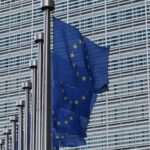
Under the slogan ‘simplification’, the European Union is changing numerous laws protecting human rights, the environment and consumers. With twelve so-called omnibus packages, the European Commission wants to reduce reporting requirements, speed up approval procedures and reduce regulatory requirements for companies. These include the European Supply Chain Act (CSDDD), sustainability reporting (CSRD), chemicals and environmental law as well as data protection and artificial intelligence.
The PowerShift briefing “We are being overwhelmed – European bus and coach laws and their impact on human rights, the environment and consumers” analyses the ten omnibus packages taken into account by the cut-off date. It explains the political background to the EU's deregulation agenda, examines the impact on human rights, the environment, consumer protection and democratic decision-making processes, and shows the interests behind the legislative changes. The now additionally submitted omnibus packages on taxes and energy products are taken into account in the updated overview on this page (as of: October 2026).
What are the Omnibus Laws?
Omnibu proceedings bundle amendments to several laws in a single legislative procedure. Initially, they were intended to facilitate technical adjustments and efficiently update existing legislation.
However, the current omnibus packages have a different goal. They serve to reduce reporting requirements, speed up approval procedures and reduce regulatory requirements for companies. Within a short period of time, the European Commission has put forward several omnibus packages covering almost all key areas of European regulation.
A deregulation agenda with far-reaching consequences
Omnibus laws are fundamentally changing European legislation. Among other things, the following are affected:
- Human rights along global supply chains
- Climate and environmental protection
- Consumer protection
- Data protection and digital fundamental rights
- Chemical and product safety
- Agriculture and circular economy
- Public investment
- Regulation of artificial intelligence
Numerous organizations and scientists criticize not only the content changes, but also the procedure. The Omnibus laws were drafted without comprehensive impact assessments and in shortened consultation procedures.
In November 2025, the European Ombudsman found that the Commission had committed maladministration in the preparation of Omnibus I (Case 983/2025/MIK). In their Final decision of June 2026 She sticks to her criticism.
Overview of the most important changes
Supply Chain Law and Sustainability Rules Are Weakened
The first omnibus package amends the European Supply Chain Act (CSDDD), Sustainability Reporting (CSRD) and the CO₂ Border Adjustment Mechanism (CBAM).
Significantly fewer companies will be subject to due diligence and reporting obligations in the future. At the same time, uniform civil liability across Europe is eliminated and binding transformation plans to meet the climate targets are weakened.
Environmental and agricultural law come under pressure
Environmental and nature conservation requirements are also withdrawn. The common agricultural policy will continue to be deregulated and environmental requirements and controls will be reduced. Other omnibus packages include circular economy, industrial emissions and environmental impact assessments.
Less protection for chemicals and products
The European Commission is planning longer transitional periods for substances hazardous to health, as well as facilitation of labelling and reporting requirements for chemical products, including cosmetics. Critics warn against weakening the precautionary principle and consumer protection.
Data protection and AI rules are relaxed
Digital fundamental rights are also under scrutiny. These include facilitation of the processing of personal data and the subsequent introduction of safeguards for high-risk artificial intelligence applications.
| packet | Presented | Rules concerned | Core changes | Stand |
|---|---|---|---|---|
| I – Sustainability | 26.02.2025 | Supply Chain Act (CSDDD), Sustainability Reporting (CSRD), Carbon Border Adjustment (CBAM) | Reporting obligation only from 1,000 employees and €450 million turnover, due diligence obligations only from 5,000 employees and €1.5 billion. EU-wide civil liability and obligation to adopt climate plans are eliminated. CBAM only applies to around 10 % the companies covered so far. | In force since March 2026 |
| II – EU investment | 26.02.2025 | InvestEU, European Fund for Strategic Investments | EU guarantees increase by €2.9 billion, while companies' reporting obligations fall. | In force since 24.12.2025 |
| III – Agricultural policy | 14.05.2025 | Common agricultural policy, in particular environmental standards (GAEC) | More permanent grassland may be converted into arable land. Controls for farms up to 30 hectares and for organic farms are omitted. | In force since 01.01.2026 |
| IV – Small mid-caps and digitalisation | 21.05.2025 | Obligations for companies with 250 to 750 employees, including GDPR, Battery Regulation, F-gases | SME exemptions will be extended to larger firms. Less data protection documentation, due diligence obligations of the Battery Regulation are omitted for these companies. | Provisional agreement in June 2026 |
| V – Defence readiness | 17.06.2025 | Public procurement law in the armaments sector, chemicals law (REACH, CLP), biocides regulation | Fewer national permits for arms trade in the EU. Member States may derogate from chemicals legislation for defence reasons. | Definitively adopted by the Council in October 2026 |
| VI – Chemicals | 08.07.2025 | Chemical Labelling (CLP), Cosmetics, Fertilizers Ordinance | Longer deadlines for the labelling of dangerous substances. Cosmetics with newly classified carcinogenic ingredients will remain on the market for longer. | Provisional agreement in June 2026 |
| VII – Digital | 19.11.2025 | GDPR, Cookie Rules, Data Act, AI Act | Pseudonymized data is no longer considered personal, the right of access is restricted. High-risk AI rules will only apply from December 2027. | AI part adopted, rest in negotiation |
| VIII - Environment | 10.12.2025 | Waste legislation, industrial emissions, REACH, environmental assessments, including the Habitats and Water Framework Directives | The database of substances of concern in products (SCIP) and the obligation to find safer substitutes are no longer necessary. Environmental assessments are streamlined. | In negotiation, Council has established its position |
| IX – Automotive industry | 16.12.2025 | CO2 fleet limits for passenger cars, requirements for e-mobility | New category ‘small electric cars’, exempted from new safety requirements for 10 years. The accompanying package loosens the combustion engine out from 2035. | In Negotiation |
| X – Food and feed | 16.12.2025 | Ten laws and four directives, including the Pesticides and Biocides Regulations | Regular reviews of pesticide active substances are largely omitted and permits are granted indefinitely, for example for glyphosate. Consumption periods double to three years. | In Negotiation |
| XI – Taxation | 24.06.2026 | taxation | Submitted after the cut-off date of the briefing | proposal |
| XII – Energy products | 24.06.2026 | Energy product legislation | Submitted after the cut-off date of the briefing | proposal |
Another package for citizens is announced for the end of 2026. Sources: PowerShift briefing “We are being rolled over”, European Commission, Council of the EU.
Why Briefing is Important
Omnibus packages are complex, negotiated in parallel and cover a wide range of policy areas. As a result, it is often difficult for politically interested parties to keep track of the situation.
For the first time, the briefing provides an overall picture of the European bus and coach agenda and provides:
- a comprehensible introduction to omnibu procedures;
- an overview of all bus and coach packages known by June 2026;
- a classification of the political backgrounds and the most important actors,
- an analysis of the impact on human rights, the environment, consumer protection and democracy;
- a compact basis for policy makers, journalists, academia and civil society.
The publication thus offers a sound orientation towards one of the most far-reaching legislative processes in the European Union at present.
Download Briefing
If you want to understand how the European deregulation agenda is developing and what consequences it has for human rights, environmental protection and consumer protection, you will find in the briefing “We are being overwhelmed – European bus and coach laws and their impact on human rights, the environment and consumers” A thorough analysis of current developments.
Download the briefing now for free. Available as print here.
Press & Background
For interviews, audio and data please contact:
Press and Public Relations Unit
presse@power-shift.de
Bettina Müller
Trade and Investment Policy Officer
Bettina.Mueller@power-shift.de
newsletters
The PowerShift newsletter regularly informs about new studies, background analyses, events and political developments.
Co-editors
Acting differently Austria
ATTAC Germany, ATTAC Austria
Coordination against BAYER dangers
Monsters of bureaucracy
FIAN Germany
Forum Environment & Development
GLOBAL2000
Stop the chainsaw!
LobbyControl
Pesticide Action Network UK