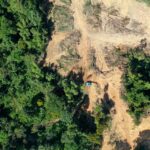
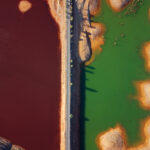
Mining can pollute water bodies and endanger the livelihoods of local communities. Our Water Watchdogs guide shows how communities can study water quality, document changes and use the results to protect their waters and enforce their rights.
During the mining and processing of ores, heavy metals, chemicals and sediments can enter water bodies. The consequences affect people, animals and entire ecosystems. In order to make pressures visible and to demand protection measures, affected communities need access to information about the status of their waters.
The brochure ‘Water Watchdogs: Guidance for community-based water monitoring’ provides the basis for community-organised monitoring of streams and rivers. It is aimed at local communities, initiatives and civil society organisations.
Measuring water quality, documenting changes
Community-based water monitoring combines local knowledge with regular measurements and systematic observations. Members of local communities examine their waters at designated locations and document the results according to a uniform procedure.
In this way, differences between measuring points and changes over longer periods of time can be detected. The comparison between locations above and below a possible entry source is particularly revealing.
Comprehensibly documented data can strengthen the position of affected communities: in discussions with authorities, in complaints, in consultation and approval procedures as well as in public relations. Community monitoring can complement state controls. The responsibility of public authorities and companies for the protection of waters remains.
What the guide conveys
Plan monitoring and carry it out safely
In the beginning there is a clear question: For example, does the water quality change below a mine? Do abnormalities occur after heavy rainfall?
The guide explains how to select suitable measuring points, set timelines and resources, and prepare field days. It describes the equipment and the sampling procedure. The safety of all parties involved is a priority: Samples may only be taken if secure access is possible.
Document measurements and observations
The brochure presents metrics for water quality and water conditions: Temperature, pH, conductivity, water hardness, turbidity, alkalinity and flow rate. It explains what these values say and how they can be measured.
Visible changes such as discoloration, deposits, foaming or fish death are also part of the documentation. Uniform protocols, photos and clearly labeled samples help to compare and verify results later.
Review and use results
A single conspicuous measured value does not yet prove mining-related pollution. Regular comparative measurements and supplementary laboratory analyses help to check abnormalities and better classify possible loads.
The guide describes typical sources of error, quality assurance measures and the limits of test kits. It also shows how results can be evaluated and communicated to authorities, companies and the public.
Download brochure and sampling protocol
Water Watchdogs – the brochure
In ten steps, the guide leads from the first question to the sampling to the evaluation and use of the results. A proposal for a simple entry-level program and a reaction sample complete the guide. Here to download.
Sampling protocol for water monitoring
The sampling protocol supports uniform documentation in the field. It is used to record information about the measuring point, time, weather and water level as well as measured values and visible abnormalities.
contact
Vanessa Fischer
PowerShift e.V.
Email: vanessa.fischer@power-shift.de
More about the topic
Water resources and public participation in the European raw materials policy