
1. ISDS – VIP rights for investors
Already more than a decade ago, the then EU Trade Commissioner Cecilia Malmström described corporate litigation – abbreviated to ISDS (investor-state dispute settlement) in English and German – as the “most poisonous abbreviation in Europe”. Since then, there has been little to revise in this assessment: States are being overwhelmed with more and more lawsuits before non-transparent arbitral tribunals, including the Federal Republic of Germany.
But why do foreign investors choose this legal remedy, which is often longer and more costly for them than a lawsuit before national courts? The arbitration system offers them decisive advantages: They play a decisive role in the selection of arbitrators, often business lawyers at large law firms who decide the case. Environmental rules or social issues play little role before arbitral tribunals – whether an investor’s expectations have been disappointed or treated “unfairly”. In addition, much higher compensation can often be obtained before arbitration tribunals than before national courts. Arbitration awards are also difficult to challenge and can be enforced worldwide.
These features of the ISDS system give investors a powerful tool to take action against democratic decisions, for example in climate policy or sanctions against Russia. States then have to decide whether to either seek a compromise with the investor (and, for example, weaken a law) or engage in an expensive procedure, at the end of which a high compensation payment can be made.
The number of ISDS cases has risen sharply over the past two decades. Although there have been legal remedies since the late 1960s, nearly 85% All complaints have taken place in the last 20 years. Germany was also affected by lawsuits at an early stage, but in recent years particularly sensitive policy areas such as climate policy, sanctions related to Russia or the management of the energy crisis have been added. German investors also use the group lawsuit system vigorously and sue states worldwide. This underlines the need for political action: The system of corporate litigation must urgently be terminated.
2. Ongoing lawsuits against Germany
2.1 Azienda Elettrica Ticinese: A lot of money for the coal phase-out
The Swiss municipal energy supplier Azienda Elettrica Ticinese (AET) is using the Energy Charter Treaty to sue the Federal Republic for a compensation of millions for the phase-out of coal-fired electricity generation – thus calling Germany's climate policy into question. The lawsuit attacks the central mechanism for shutting down German hard coal-fired power plants. The German coal phase-out law of 2020 regulates the order of shutdowns and the amount of compensation through an auction system. Operators receive compensation for an early shutdown of their power plants – in the event of a later shutdown, they go empty-handed.
AET is just under 16% involved in a power plant in Lünen in the northern Ruhr area, which was not successful in any of the auction rounds and will therefore be shut down without compensation in 2031. Now the company wants to sue an ISDS lawsuit against the German legal situation compensation of about 100 million euros, although it had invested only 23 million euros in the power plant. This investment in Switzerland was very controversial and the AET could only avert a referendum against the entry into the power plant by committing to get out of the power plant by 2035. Nevertheless, it now wants to be compensated for a hypothetical operation of the power plant until 2053 – long after Germany has committed to be climate neutral.
If AET succeeds with the lawsuit, it could set a precedent and encourage other investors in hard coal-fired power plants to follow similar procedures. Thus, the architecture of the German coal phase-out would be at stake – although scientists consider it to be particularly efficient and comparatively cost-effective for public budgets. Together with other civil society organisations, PowerShift therefore tried to get involved in the proceedings with a brief. However, this was rejected by the arbitral tribunal.
2.2 Klesch: A financial investor attacks the excess profit tax
The Russian attack on Ukraine in 2022 led to an explosion in energy prices in Europe and at the same time to a massive increase in profits of oil and gas companies. In response, the EU introduced an over-profit tax for energy companies aimed at easing the burden on consumers. This brought about 28 billion euros to the states of the European Union.
The US billionaire and financial investor Gary Klesch was also affected by the excess profit tax. He initially bought an oil refinery in northern Germany in 2010 and another Denmark in 2021, the taxation of which led to the group lawsuits. Financial analysts describe his business model as the purchase of fossil-fuel assets at relatively low prices, in order to then burden these assets with debt and thus achieve high profits. During the energy crisis, at least its Danish refinery, for which official figures are available, made unusually high profits. For these, the company, like all other companies, should pay the excess profit tax due.
But Klesch did not want to let this sit on him and is now suing Germany, Denmark and the EU on the basis of the Energy Charter Treaty before an arbitral tribunal. In doing so, he demands not to have to pay the excess profit tax, or their complete refund. In Germany, this amounts to 116 million euros, the amount demanded in the proceedings against Denmark is not known. In a highly unusual decision, the arbitral tribunal already ordered that Germany should initially not be allowed to collect the taxes at all – a serious interference with tax sovereignty. If Klesch succeeds with this, many more lawsuits are likely to follow and EU states would have to pay back billions to fossil-fuel corporations, at the expense of those who already had to dig deep into their pockets for the excess profits of the corporations.
2.3 Rusal: How Group Lawsuits Are Questioning Sanctions
Following the Russian invasion of Ukraine in February 2022, the EU imposed sanctions on the Russian state bank VTB. Germany consistently implemented this policy: The German financial supervisory authority BaFin withdrew control of its German subsidiary from the VTB parent company. The bank lost its license in Germany, the German subsidiary was renamed OWH and has since been wound up. Even before the attack on Ukraine, the German VTB branch maintained business relations with the Russian aluminium producer Rusal. Its largest shareholder is the EU-sanctioned oligarch Oleg Deripaska. The liquidators of the OWH appointed by the German supervisory authorities now demanded collateral from Rusal from an ongoing currency business. Rusal did not pay with reference to the sanctions and after a lawsuit by the OWH, a London court ordered Rusal to pay around 214 million euros. Courts in several countries, most recently the UK, have upheld this ruling.
Now Rusal turns the tables: On the basis of an investment protection agreement that Germany had still concluded with the Soviet Union, the company sues the Federal Republic and demands back exactly the amount it owes itself. The case exemplifies how ISDS can become an instrument to pass on the costs of sanctions policy to European taxpayers. Because Rusal is not the only actor who uses this method: A total of 23 corporate lawsuits have been filed by sanctioned companies and oligarchs against Ukraine's supporters, demanding compensation of more than $42 billion. Among them is the Russian VTB Bank, which has also threatened a corporate lawsuit against Germany.
2.4 The Thai mystery
Another ISDS case against Germany only recently became known through a written question from the Bundestag, he is not to be found in publicly accessible registers for group lawsuits. And the details remain sparse: The German Government's reply shows that this is a lawsuit under the bilateral investment protection agreement between Germany and Thailand. The Thai investor demands compensation in the double-digit million range. The Federal Government does not reveal what the dispute is about. Specialist media speculate that the case is related to an ISDS lawsuit against Thailand and the subsequent insolvency of the German construction company Walter Bau.
3. Complaints against Germany that have already been closed
The Swedish energy company Vattenfall went into the proceedings Vattenfall I against the environmental and water requirements for the controversial coal-fired power plant Hamburg Moorburg. Vattenfall demanded 1.4 billion euros in compensation for the environmental and species protection regulations issued by the Hamburg Senate. Ultimately, the ISDS lawsuit was settled after the environmental regulations were softened and Vattenfall was allowed to remove more cooling water from the Elbe. A few years later, the European Court of Justice condemned the Federal Republic of Germany for violating European nature protection directives at the Moorburg coal-fired power plant.
Shortly thereafter, the same group put in Vattenfall II Another lawsuit against Germany. This time, the Swedish company sued against the early nuclear phase-out after the Fukushima disaster. Vattenfall demanded compensation of 6-7 billion euros (the exact amount was not published) because previously agreed residual electricity volumes could not be used. Here, too, the Federal Government entered into a settlement – after the Federal Constitutional Court had upheld the nuclear operators in a parallel lawsuit – and paid Vattenfall 1.4 billion euros to avert a ruling by the arbitral tribunal.
Two lawsuits against the Federal Republic of Germany over disputes over the construction of offshore wind farms in the North Sea have already been decided. An arbitral tribunal ordered Germany to pay approximately EUR 350 million (including interest) to the Austrian construction group. Strabag delays in grid connections and changes in support conditions for renewable energy. Strabag had invested only 120 million euros, according to its own information. Although the procedure is still in a phase of cancellation initiated by Germany, it is very rarely successful. At the same time, Strabag has initiated the enforcement of the EU-infringing judgment in the USA, which could lead to the confiscation of German state assets. A similar lawsuit against Germany lost the company Mainstream Renewable, as according to the referees, the investment was not yet sufficiently advanced.
About the action Sancheti There is little public information against Germany from 2000, which was submitted under the Germany-India Agreement. It appears to be an action in the services sector which has been discontinued or where a settlement has been reached.
4. Complaints by German investors
While Germany has so far been sued in eight cases, German investors have brought a total of 90 cases against other states. This puts them in fourth place in the world; Only investors from the US, the UK and the Netherlands have filed more lawsuits. Their claims against foreign states amount to almost $13 billion, with only about two-thirds of all cases knowing the amount of the lawsuit. Many of these lawsuits have been brought against other EU Member States, which is illegal under European law.
Particularly controversial were the lawsuits of the major German energy companies RWE and Uniper against the Dutch coal phase-out. The Netherlands had to step up its climate efforts to bring them into line with its commitments under the Paris climate agreements. This included the earlier shutdown of two coal-fired power plants. Already during the legislative process, the two German companies threatened to bring a group action – arguably in order to weaken the law – and demanded compensation of a total of EUR 2.4 billion from the Netherlands in their actions. Both cases were ultimately terminated. Uniper was forced to take this step when the German government saved the company from bankruptcy. RWE withdrew the action after German courts found at last instance that the arbitration proceedings were contrary to EU law.
The case of the German-Swiss aristocratic family also attracted a lot of attention by Pezold, which brought an ISDS lawsuit against Zimbabwe. The family's large agricultural and forestry lands in Zimbabwe were redistributed and occupied in the early 2000s as part of a land reform. In the subsequent ISDS lawsuit, Pezolds claimed compensation of $270 million (including interest) unless the country was reimbursed (which would still result in compensation of $65 million + interest). The case was particularly controversial due to the fact that the arbitral tribunal did not allow four indigenous communities in Chimanimani, who consider the lands ancestral land, to participate in the proceedings. Instead, they were consistently referred to as “invaders”. There was no place for their human rights in the trial. Since no compensation has been paid by Zimbabwe so far, Pezolds are trying to collect the money from the heavily indebted country in U.S. courts.
Corporate lawsuits are also increasingly directed against the sanctions policy of war-torn Ukraine. Among them is the German company AEROCC Investment. It belongs to the LSR Group of the Russian oligarch Andrei Molchanov. The US has been listing the group and its owner on the "Kremlin List" of Putin-affiliated actors since 2018. It is also on the sanctions lists of the EU, Switzerland and Canada. Ukraine moved in the holding’s two concrete plants in 2023 on the basis of its Sanctions Act. The explanatory memorandum: LSR supports the war of aggression through tax payments, mortgage programs for soldiers and housing for the Russian military. The works were auctioned to a Ukrainian entrepreneur for $45 million. The holding company is now demanding compensation from the attacked country, based on the investment protection agreement between Germany and Ukraine. A sanctioned oligarch uses a German subsidiary to sue an attacked country, which is supported by the Federal Republic. And so he's not the only one: Other Russian oligarchs are also using investment protection treaties between European countries and Ukraine to sue them for compensation because of their sanctions policy. A total of ten cases are known, including the lawsuit of billionaire Mikhail Fridman, who is demanding $1 billion from Ukraine for the loss of a banking license.
5. The contracts that make group lawsuits possible
All of the group actions presented here are based on international investment protection agreements. These give foreign investors far-reaching and vaguely defined property rights and the ability to enforce them before arbitral tribunals. Most of these contracts are concluded bilaterally between two countries. No country has as many of these bilateral investment treaties in force as Germany. The vast majority of these include ISDS clauses that give corporations and oligarchs access to arbitration. Particularly problematic: The contracts include expiry clauses (also called sunset or zombie clauses) that allow the contract to continue to apply to existing investments after termination. Throughout Europe, Germany has the longest expiry clauses of an average of 18 years. For this reason, among others, an analysis by PowerShift concludes that German investment protection policy and its effects are among the three most harmful in Europe.
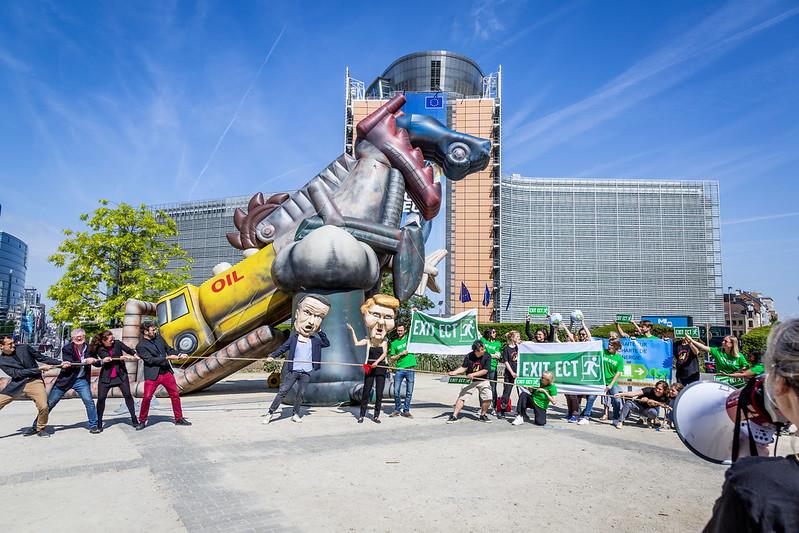
Nevertheless, it is possible to reduce the risk of corporate lawsuits. Many countries have terminated contracts with ISDS, such as Indonesia, South Africa, India and Ecuador. Germany has already done so: Following a ruling by the European Court of Justice, all investment protection treaties between EU member states had to be terminated. The contracts were terminated in such a way that the expiry clause was lifted beforehand – the risk of legal action disappeared immediately. Germany, the EU and many other European countries also withdrew from the Energy Charter Treaty, which is responsible for a particularly large number of corporate lawsuits. In this case, however, the expiry clause has been insufficiently restricted. In addition, the EU is trying to complicate lawsuits by Russian oligarchs without, however, terminating the underlying treaties. What is missing, however, is a strategy of the Federal Government to limit the danger posed by the existing German investment protection agreements. This is despite the fact that the Federal Government itself has described these contracts as ‘out of date in many respects’.
6. Conclusion: High time for the ISDS exit
Although they are no longer so much in the public eye, corporate lawsuits have by no means disappeared. On the contrary: They are becoming an ever-increasing problem and limiting democratic scope for action in key areas, including Germany. Lawsuits against the coal phase-out make the fight against climate change more expensive and complicated, arbitrations question the excess profit tax and thus an important tool to cope with the energy crises, complaining oligarchs put pressure on Ukraine and its supporters.
Germany plays an important role in this system. No country has concluded so many investment protection agreements, only a few countries have so many corporate lawsuits – and at the same time the Federal Republic of Germany is increasingly becoming the target of such lawsuits. The solution is obvious: The termination of the agreements enabling these actions, ideally with the prior neutralisation of the expiry clause – as has already been done with the treaties between EU states. Germany can and must play a pioneering role here.
Photo: Protest in Brussels for the ECT exit (c) Lode Saidane

