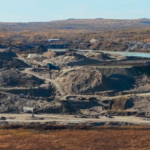
Berlin, 18.10.2022: The Civil Society Network AK Raw Materials calls for a reorientation of German raw materials policy at its raw materials summit, which will take place today from 1 p.m. The German government's future raw materials strategy should no longer ignore the fact that Germany's enormously high demand for raw materials is at the expense of people, the environment and the climate. In one today published receivables document The working group formulates requirements for such a new strategy.
“The former Federal Governments’ raw material strategies of 2010 and 2020 have failed. The new raw materials strategy must be a raw materials transition strategy: Their goal must be to reduce the need for primary raw materials in absolute terms, to put a circular economy at the centre and to enforce the highest human rights and environmental standards along the supply chain", says Hannah Pilgrim, Coordinator of the AK Raw Materials.
“In Argentina, lithium mining is already having serious consequences for the fragile ecosystem in the mining regions. Local communities fear for their water resources and therefore for their livelihoods. The projected increase in global lithium demand will further exacerbate the situation on the ground. In particular, respect for the rights of indigenous communities on the ground must therefore be ensured. This includes the right to say 'no' to mining after a prior free and informed consultation", says Pia Marchegiani from the Foundation for Environment and Natural Resources FARN, Partner organization of Bread for the World from Argentina.
“German companies are responsible for their activities abroad. The German Supply Chain Act is a first step. However, those affected by dam breaks, for example, are difficult to convey that the Supply Chain Act does not create a basis for them to claim damages if German companies disregard human rights abroad. The Federal Government must change its raw materials policy and promote stricter rules for the benefit of the vulnerable at EU and UN level”, says Pirmin Spiegel, Managing Director of MISEREOR. “Federal Minister for Economic Affairs Robert Habeck should use his visit to the BDI Raw Materials Congress to confirm this.”
“In order to finally use fewer raw materials, the Federal Government must set legally binding resource protection targets. This also means that products are reused more often and that recycled materials take precedence over newly produced substances. Germany needs a coherent circular economy strategy with the aim of avoiding waste, e.g. setting and enforcing recycling rates and resource efficiency targets, and making repairability the standard. Anyone who wants companies to invest in this sense must create a reliable framework", says Antje von Broock, Managing Director of the German Association for the Environment and Nature Conservation (BUND).
On a total of three panels, civil society representatives from Argentina, Brazil, Germany and the DR Congo will discuss alternatives to German raw materials policy with representatives from ministries, science, industry and trade unions in the afternoon.
The interlocutors are among others. Dr. Franziska Brantner (Parliamentary State Secretary, BMWK), Dr. Bettina Hoffmann (Parliamentary State Secretary, BMUV), Herwart Wilms (Remondis, recycling companies) and Dr. Manuel Bickel (Wuppertal Institute).
You can watch the raw material summit live stream from 1 p.m. today.
You can access the receivables document of the AK Rohstoff via this link.
In the run-up to the Raw Materials Summit, the AK Raw Materials had the 4th edition from October 10-17. Alternative Raw Materials Week. The current issue is the development of a new Raw material strategy by the Federal Government, which critically accompanies the AK Raw Materials as a civil society. The Bundesverband der Deutschen Industrie (Federal Association of German Industry) is also organising a Raw materials congress.
The Working Group (AK) Raw Materials is a network of German non-governmental organizations that has been advocating for the highest human rights and ecological standards along metallic-mineral raw material supply chains since 2008 and calls for a change in German raw material policy.
Press contact
Vanessa Fischer (Press Officer, PowerShift e.V.)
Email: vanessa.fischer@power-shift.de
Telephone: 0157 547 68 413