Race for critical raw materials endangers human rights and the environment worldwide / Stronger focus on reduction and circular economy
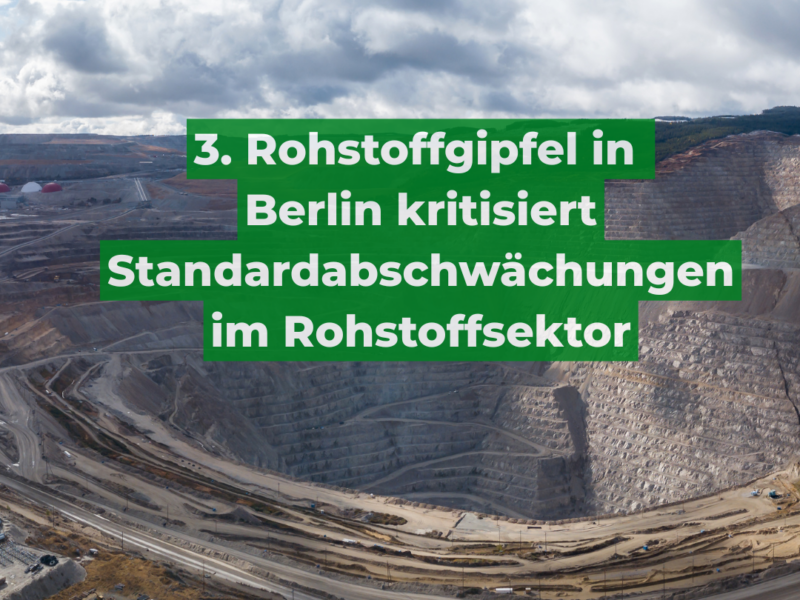
Berlin, 5 October 2026. The civil society alliance Working Group on Raw Materials (AK Rohstoffe) warns against the threat of further weakening of environmental and human rights standards. In September, European Commission President Ursula von der Leyen again warned of Europe’s dependence on ‘critical raw materials’, in particular China, and called for stockpiling. The aim is to diversify supply chains, speed up permitting procedures for projects within the EU and further simplify EU regulations. In the case of the 3rd Raw material summit in Berlin on 6 October, experts will discuss the negative consequences of increasing raw material consumption and the weakening of protection standards as well as political solutions.
Ursula von der Leyen’s recent announcement to further advance the EU’s Simplification Agenda could further undermine environmental, human rights and participation standards in raw material projects. The "simplification" argument aims to drastically reduce bureaucracy, administrative costs and reporting requirements. However, protection standards are de facto weakened in many areas, as has already happened with the EU Supply Chain Directive.
More than half of the resources for future technologies, including lithium, nickel and copper, are located on or near the land of indigenous peoples. Projects in indigenous territories are also to be expanded in northern Europe. Elsewhere, for example in Portugal, local communities are not sufficiently involved in decision-making.
Worldwide, social conflicts threaten to be exacerbated by mining projects. “In northern Argentina, lithium mining threatens a sensitive ecosystem and the livelihoods of indigenous communities. For years, they have complained of a violation of their rights, which provide for free, prior and informed consent or rejection of the extraction of raw materials. In the province of Catamarca, a river has already dried up. The lithium mined there also ends up with German car manufacturers, among others.’, says Pía Marchegiani of FARN, an Argentine partner organization of Bread for the World.
The AK Rohstoffe calls for a fundamental change in its newly published paper. “Less consumption of raw materials and a comprehensive circular economy reduce pressure on mining regions worldwide, reduce dependencies and also increase the EU’s resilience. This requires binding targets to reduce primary raw material consumption to a sustainable and globally equitable level and to strengthen the circular economy, but without weakening circular value chains in the Global South.”, says Hannah Pilgrim, Coordinator of AK Rohstoffe, and emphasised that: ‘To date, around 90 percent of the raw materials used worldwide are used only once. A consistent circular economy has the potential to reduce global primary production of some raw materials by up to 40 percent by 2050. The opportunity must be seized through an ambitious Circular Economy Act!”
Huge environmental hazards could also be reduced: For example, a single tonne of purified rare earths generates up to 2,000 tons of toxic waste. A massive expansion of mining – increasingly driven by growing demand from areas such as AI and the defence industry – threatens to destroy habitats on a large scale. “The well-being of people and the environment must not be subordinated to economic and geopolitical interests”, says Hannah Pilgrim and adds: ‘In addition, fundamental changes are needed in our global economic, trade and financial system, which continues to hold many countries in the Global South to the role of commodity exporters without sustainable local added value.”
Background:
In the case of Raw materials summit on 6 October in Berlin Representatives from politics, (inter)national civil society, academia and trade unions discuss ways of a sustainable and globally just raw materials policy. The hybrid event is the political highlight of the ‘Alternative Raw Materials Week 2026’. Other Information on the Raw Materials Summit and the possibility to register you will find here: https://ak-rohstoffe.de/veranstaltung/rohstoffgipfel/
The Working Group on Raw Materials (AK) is a network of German non-governmental organisations that promotes the highest standards along metallic-mineral raw material supply chains and calls for a change in German raw material policy. The receivables paper of the AK Rohstoffe can be found here: https://ak-rohstoffe.de/wp-content/uploads/2026/10/2026_AK-Rohstoffe-Fakt-Forderungen_Web.pdf
Note to editors: For interview requests with participants of the Raw Materials Summit, please contact the following press offices:
Press contact Bread for the world
Tommy Ramm, Press Spokesman, Bread for the World
Tel: 030 65211 1225, mobile 0162 255 3859
tommy.ramm@brot-fuer-die-welt.de
Press contact PowerShift e.V.
Lisa Stüve, Press Officer PowerShift e.V.
Mobile 0157 777 64847
Lisa.stueve@power-shift.de